Home Comfort & Climate Guides
Dehumidifier Buying Guide
How to choose a dehumidifier: pint capacity, drainage options, noise, and basement vs whole-room sizing explained plainly.


Buying Guide
Basements and spare rooms need a set-it-and-forget-it pint count — not a unit that cycles loudly or shuts off before humidity actually drops. Match capacity to room size and drainage reality.
Top questions
- What makes a good dehumidifier?
- How many pints do you need?
- Bucket, gravity hose, or pump?
- Where should it live in the room?
- Models worth a closer look
- How much should you spend?
- What to read next
What makes a good dehumidifier?
A dependable unit pulls moisture steadily, hits your target humidity, and drains without daily bucket duty if you need hands-off operation.
Oversized is better than undersized in wet basements — an underpowered bot runs constantly and still leaves musty air.
Buyers prioritize timer (50% of top products include it vs 49% overall).
Buyers prioritize smart (50% of top products include it vs 45% overall).
Start with how you actually use the dehumidifier — daily rhythm matters more than the longest feature list on the spec sheet.
How many pints do you need?
Use pints per day ratings as a ceiling, then round up for damp concrete, laundry rooms, or standing water history.
A 30-pint class works for modest rooms; busy basements often need 50-pint or higher depending on square footage and moisture load.
Measure twice — returns on bulky dehumidifier are expensive. Photograph your space with a tape measure in frame so you can compare against cutout diagrams on the product page.
When you are ready to compare models, See all 97 dehumidifiers in our lineup — filter by price and the specs that matter most to you.
Round up for damp concrete, laundry rooms, or chronic moisture — rated pints are a ceiling, not a guarantee.
Bucket, gravity hose, or pump?
Gravity drains to a floor drain are simplest if the outlet sits lower than the unit. Built-in pumps lift water to a sink when gravity will not work.
If you will empty buckets, check tank size and full-tank shutoff — otherwise the unit pauses when you are not home.
When you are ready to compare models, See all 97 dehumidifiers in our lineup — filter by price and the specs that matter most to you.
Where should it live in the room?
Compressors hum — plan placement away from bedrooms unless you buy a quieter tier. Leave airflow space on all sides per the manual.
Clean filters seasonally; dusty coils slow moisture removal and raise power bills.
Decibel ratings are useful for comparison within one brand line, but room acoustics and install (cabinet door, open plan) change what you hear. Prioritize relative quiet tiers when the machine runs while people are home.
When you are ready to compare models, See all 97 dehumidifiers in our lineup — filter by price and the specs that matter most to you.
Top-ranked models worth considering
These are some of the top-rated, well-reviewed dehumidifier in our catalog — strong examples while you learn what to shop for. This is not our full ranked list. See all 97 dehumidifiers in our lineup or see our roundup when you are ready to buy.
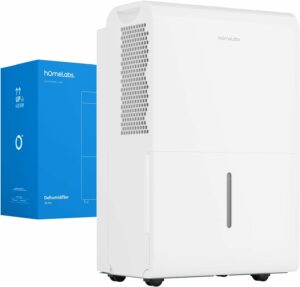
hOmeLabs 50-Pint Wi-Fi Dehumidifier for Large Rooms
Wi-Fi enabled 50-pint dehumidifier for large spaces, controlled from anywhere.
hOmeLabs has built a reputation on straightforward, effective home appliances. Their 50-Pint Wi-Fi Dehumidifier is engineered for a single, clear task: quietly dominating the damp air in large spaces. With a claimed capacity for areas up to 7,000 square feet, it targets finished basements, open-concept living areas, and other zones where moisture lingers.
Performance hinges on real-world conditions. It extracts 50 pints per day in a standard 80°F, 60% RH environment. In hotter, more saturated spaces like a muggy basement, that capacity can peak much higher. The digital controls let you set a precise humidity level and forget it. The Wi-Fi connectivity is genuinely useful, allowing you to check levels, adjust settings, or receive a full-tank alert from your phone without trekking downstairs.
Operation is notably quiet for its size. The washable filter is easy to maintain, and the unit rolls smoothly on casters. The included continuous drain hose option is essential for long-term, hands-off use. While its physical footprint is substantial, that’s the trade-off for moving this much air. It’s a workhorse that handles the job without constant attention.
HomeGear editors evaluate and recommend products independently. Purchases through affiliate links may earn us a commission, which helps support our editorial work.
Brand: hOmeLabs
Where to find it: Amazon
Specifications
▼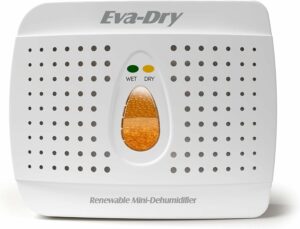
Eva-Dry E-333 Wireless Mini Dehumidifier
Compact, renewable dehumidifier that plugs in nowhere, absorbing moisture silently for months.
Eva-Dry has specialized in renewable moisture control for years. The E-333 Wireless Mini Dehumidifier distills that focus into its simplest, most portable form. This is a tool for targeted spaces, not whole-home climate control.
It works through a silica gel cartridge that absorbs up to 6 ounces of moisture. You simply hang it in a closet, place it in a bathroom, or tuck it into a camper. The unit needs no power cords or batteries, operating silently for about 20-30 days before the beads saturate. Recharging it is straightforward: plug the entire unit into a wall outlet for 10-12 hours until the indicator window turns blue. It’s effective for areas up to 333 cubic feet, making it ideal for that one persistently damp cabinet or a small storage room.
The design is spill-proof and non-toxic, so it’s safe around stored clothes or on a shelf. Just know its limits. This won’t dry out a flooded basement or a large, open living area. For a musty gym bag, a packed-away wardrobe, or a gun safe, it’s a set-and-forget solution that actually works.
Brand: Eva-Dry
Where to find it: Amazon
Specifications
▼How much should you spend?
Our dehumidifier catalog centers around a ~$140 median, with useful options below and above that mark depending on features and finish.
| Price band | What you typically get | Best for |
|---|---|---|
| Under $150 | Smaller pint counts, manual emptying, louder compressors | Small bedrooms and closets |
| $150–$250 | Mid pint capacity, better humidistats, continuous drain ports | Typical basements and living areas |
| $250–$400 | Higher pint output, pump drains on some units | Damp basements and larger open rooms |
| $400+ | Whole-home style capacity, rugged builds, advanced controls | Chronic moisture and large footprints |
What to read next
How we review dehumidifiers
We compare the details that matter in a real basement — pint capacity per day, drainage hose or pump, humidistat accuracy, and noise level. We read owner reviews and ratings, line up specs on comparable models, and editors turn that into plain advice you can use before you buy.
We do not measure pint removal rates in a climate chamber for every model we list. When we link to specific models, those recommendations come from the same side-by-side comparison — not paid placement.
Disclaimer
HomeGear Insider publishes buying advice to help you shop smarter. We are not the manufacturer or seller of the products here. Prices, specs, and availability change — double-check the details on the retailer’s site before you order. Installation, warranty, and returns are between you and the seller.



Brutal Paid Advice — The Ice Cream Shop

WALKINGPAD R3H+ 2-in-1 Folding Treadmill 7.5 mph Review for 2026

Concept2 SkiErg SkiErg Only Review for 2026

NordicTrack T Series 10 Treadmill Review for 2026

Weber Genesis S-415 4-Burner Propane Gas Grill Review for 2026

Best Humidifiers 2026: Top 50 Tested & Ranked

20 Best Sous Vide Machines for 2026: Real Picks Worth Buying

LG 38WR85QC-W 38-Inch Curved UltraWide WQHD Monitor Review for 2026

Best Dehumidifiers 2026: Top 40 Tested & Ranked

Desk Monitor Buying Guide


-
 Home Comfort & Climate Roundups5 months ago
Best Humidifiers 2026: Top 50 Tested & Ranked
-
 Kitchen & Dining Roundups5 months ago
20 Best Sous Vide Machines for 2026: Real Picks Worth Buying
-
 Home Office Reviews5 months ago
LG 38WR85QC-W 38-Inch Curved UltraWide WQHD Monitor Review for 2026
-
 Home Comfort & Climate Roundups5 months ago
Best Dehumidifiers 2026: Top 40 Tested & Ranked
-
 Home Office Guides5 months ago
Desk Monitor Buying Guide
-

 Outdoor & Garden Roundups8 months ago
Best 40 Patio Sets: The Most-Bought Picks for 2026
-
 Cleaning & Laundry Reviews5 months ago
roborock Saros 10R Robot Vacuum and Mop with Self-Emptying Review for 2026
-

 Outdoor & Garden Guides6 months ago
Patio Set Buying Guide